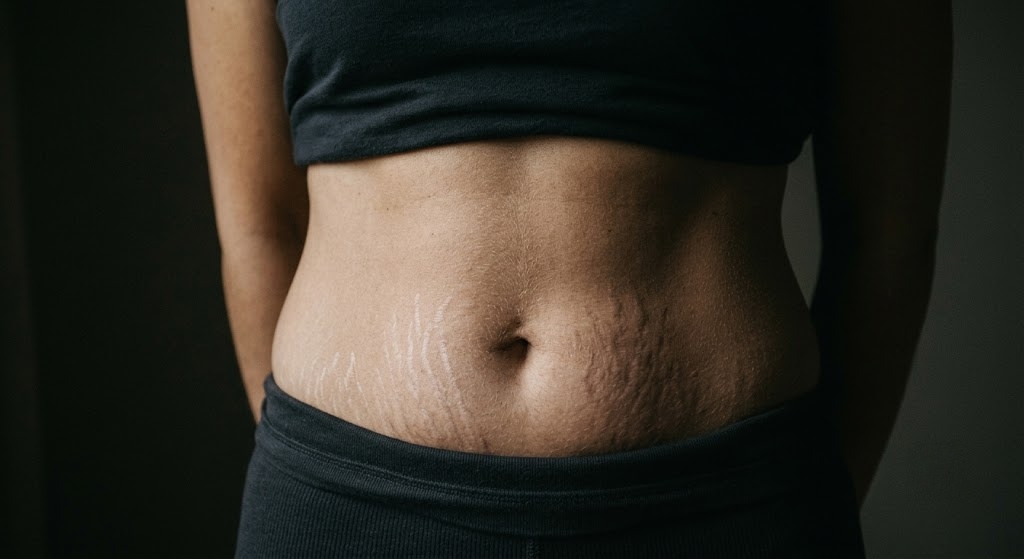
Stretch Marks and Laser: Why We Choose Picosecond
Get the explanation of why our non-ablative picosecond laser offers shorter downtime and gentler treatment of stretch marks compared to ablative CO2 lasers.
Stretch marks are a completely natural part of having a body that changes. They can occur during pregnancy, during rapid growth, or when we work out. Nevertheless, many people find that these marks take up a disproportionate amount of mental space in their daily lives.
At Past Tense, we recognize that the psychological burden of scars and stretch marks is a fully valid reason to seek treatment. You don't have to wait until it becomes "bad enough."
In this article, we dive into how we treat stretch marks with Denmark's most advanced laser, and why we prefer non-ablative picosecond technology over traditional ablative lasers like CO2 and Erbium.
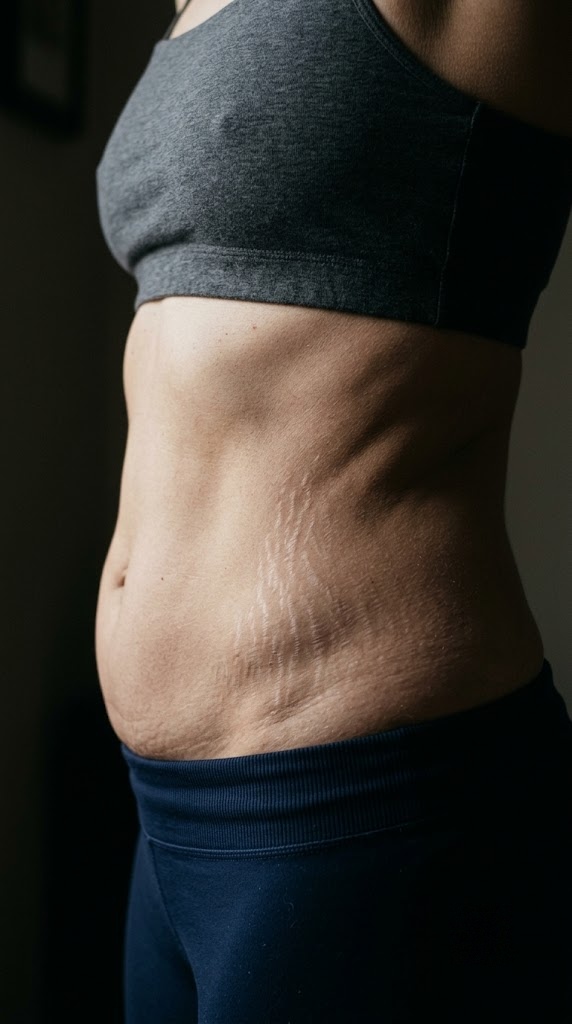
Stretch marks are legally and biologically scars
When skin is stretched faster than it can produce collagen and elastin, the underlying fibers break, and a stretch mark appears. Because stretch marks are, by nature, scar tissue, they place very specific demands on the treatment.
A stretch mark rarely disappears completely—but it can become significantly less visible, softer, and more supple. We call this the scar triad. To achieve this result, we work with the Fotona StarWalker PICO Pro, which was named Best Laser Device at AMWC Monaco 2026.
Pressure, not heat: Why we opt out of the CO2 laser
When researching treatment options for stretch marks, you often encounter the traditional CO2 laser. This is a so-called ablative laser. Being ablative means it removes the top layer of skin using intense heat, forcing the body to form new skin.
While ablative lasers have their place in medical settings, they also have significant drawbacks: they create an open wound surface, which means long downtime, risk of infection, and weeks of redness and peeling. Additionally, the heat from a CO2 laser is associated with a higher risk of pigment changes, especially in people with darker skin types.
We have chosen a different path. We work under the skin—not on it.
Our StarWalker PICO Pro is a non-ablative laser. It emits pulses of light that last only 300 trillionths of a second (300 picoseconds). Because the pulse is so ultra-short, the energy is captured before it has time to turn into heat. Instead, a photomechanical effect—a pressure—is created.
When we treat stretch marks, we use a process called LIOB (Laser Induced Optical Breakdown). The laser forms microscopic cavitation bubbles down in the dermis (the inner layer of skin), creating a shockwave. This wave triggers a controlled healing process and collagen remodeling beneath the surface, while your skin's surface remains intact.
The advantages of this method are tangible:
- Shorter downtime: Because the skin surface isn't burned away, you avoid open wounds.
- Gentler process: The treatment is overall more delicate on the tissue.
- Better comfort: The treatment can be performed virtually pain-free with medically prescribed pain relief.
In other words, the laser doesn't remake the scar—it asks your skin to do it.
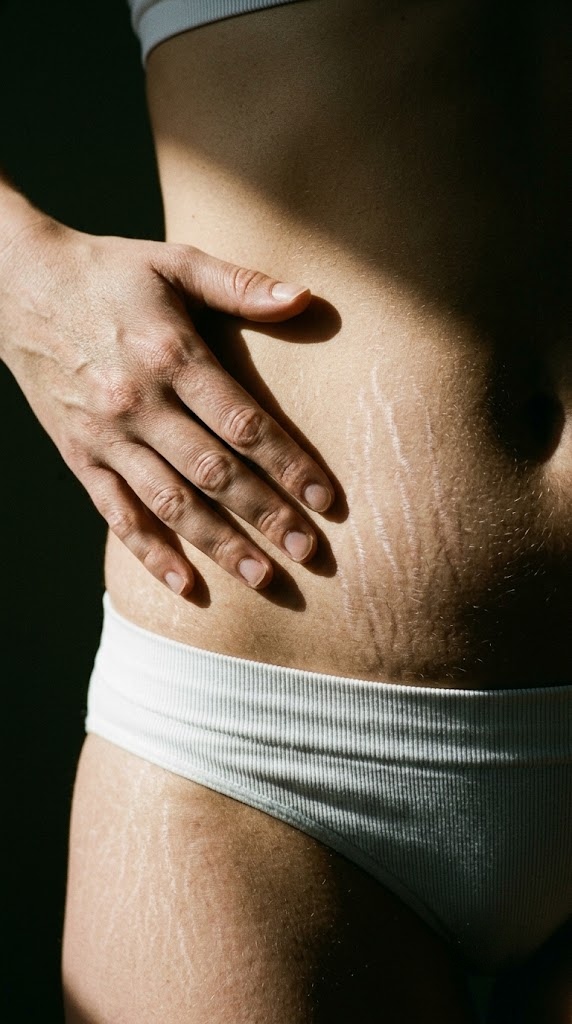
We don't make promises. We document.
We don't try to persuade you with magical promises. We would rather show you the data. Even though a picosecond laser is gentle, the effect on stretch marks is highly documented:
- In a clinical study, independent, blinded dermatologists assessed an 81% clinical improvement in stretch marks after four treatments with a picosecond laser. (— Clinical Study, Lasers in Surgery and Medicine, Fusano 2021)
- Another study showed that 9 out of 10 participants experienced a clear improvement in even mature stretch marks. (— Clinical Study, Kaewkes 2022)
(Disclaimer: Results are individual. We point out that clinical improvement in appearance is not a guarantee that stretch marks will be removed completely).
Our laser delivers the world's highest peak power in the pico-class—2.7 GW, which is approximately three times more powerful than most other picosecond lasers on the market. But as we usually say: Anyone can buy the laser. No one can buy the settings. It is our precise protocols that ensure a safe and effective treatment.
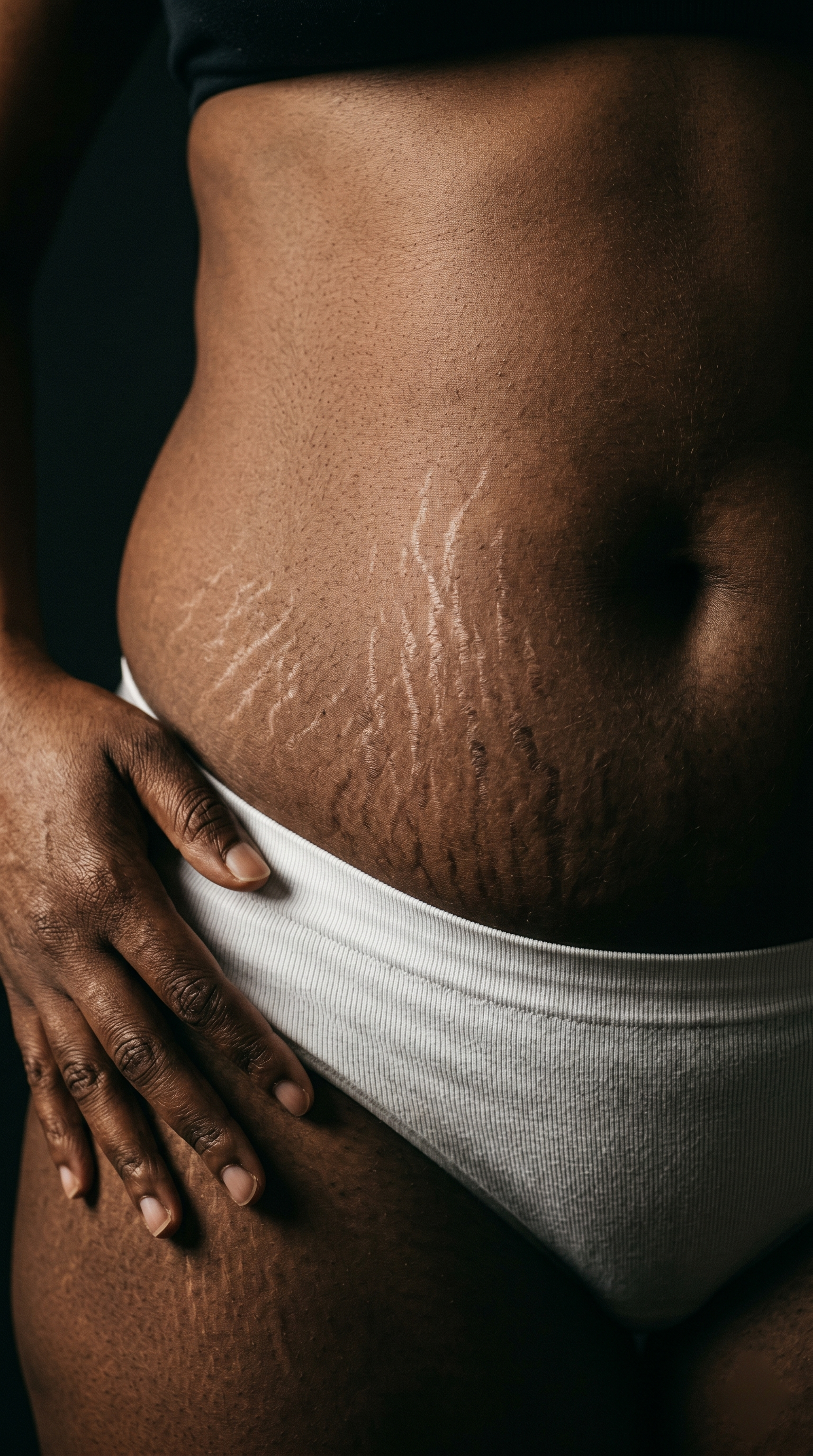
We also treat darker skin types
One of the biggest limitations of ablative lasers (like CO2) is that they are often too risky to use on Fitzpatrick IV-VI (darker skin types) due to the high risk of hyperpigmentation caused by heat.
Because our picosecond laser uses a photomechanical process rather than a thermal one, we have a significantly lower risk of unwanted pigment changes. We also treat darker skin types—those that many other clinics shy away from. The key is not to avoid the laser, but to treat with the correct settings for your specific skin. That is one of the reasons people come to us when they have been told "no" elsewhere.
How the treatment process works
A typical course for stretch marks spans 4-6 treatments.
We work with an interval of at least 4 weeks between each session. The fact that weeks must pass between sessions is not a disadvantage—it is the very foundation of the treatment. The laser starts the process, but your body creates the result during the weeks when it forms new collagen and remodels the tissue. Time is not a break from treatment; time is the treatment.
Virtually pain-free
We know that many fear the pain of laser treatment. At Past Tense, you choose your own comfort level. We work with a "comfort staircase" ranging from high-potency numbing cream to injections. For some cases, sedation may be considered following a medical assessment. As a result, we can perform the treatment virtually pain-free.
What does it cost?
The price for stretch mark treatment starts at 900 DKK per treatment. In addition, there is a mandatory insurance fee of 6% added to the treatment price. If you choose to take numbing cream home, a tube costs 300 DKK (350 DKK if we apply it in the clinic).
We do not work with discounts or package prices, but instead give you a very precise estimate and a fixed price per treatment. We are not trying to be the cheapest. We want to be the safest choice.
Our doctor decides—not an advertisement
Everything starts with a free initial consultation at the clinic. Here, our practitioner examines your skin and your stretch marks. If treatment is relevant for you, he will refer you to a medical consultation with our specialist, PhD Hans Christian Plaschke (the consultation costs 750 DKK, unless otherwise agreed).
Sometimes the answer is no. Other times, we discuss what needs to happen before we can begin. It is always a specific, medical assessment.
Important Information:
- Results are individual.
- We only treat scar tissue based on medical reasons and clinical needs (psychological burden is, as mentioned, a valid reason).
- We are registered with the Danish Patient Safety Authority and comply with the Health Act and the Executive Order on Cosmetic Treatment.
Are you ready for an honest, professional assessment of your stretch marks? Book your free initial consultation today.
Past Tense · with respect for your skin.
Get an overview of your treatment before booking
Take the first step towards the look you want, completely without obligation. Book your free consultation today and learn about your options for complete removal or cover-up of your tattoo. During your free consultation, we take a thorough look at your specific tattoo and give you a precise overview of the duration and cost of your treatment process. To start, you can try our AI tool, which in just a few minutes gives you a qualified estimate of how many treatments your desired result requires and what it will likely cost.